RoboFQE: Rollout-Free Evaluation of Visual Robot Policies from Offline Trajectories
Large-scale robot datasets can evaluate policies, not just train them.
RoboFQE estimates a policy's success rate from the trajectories you already have, without rolling the policy out.
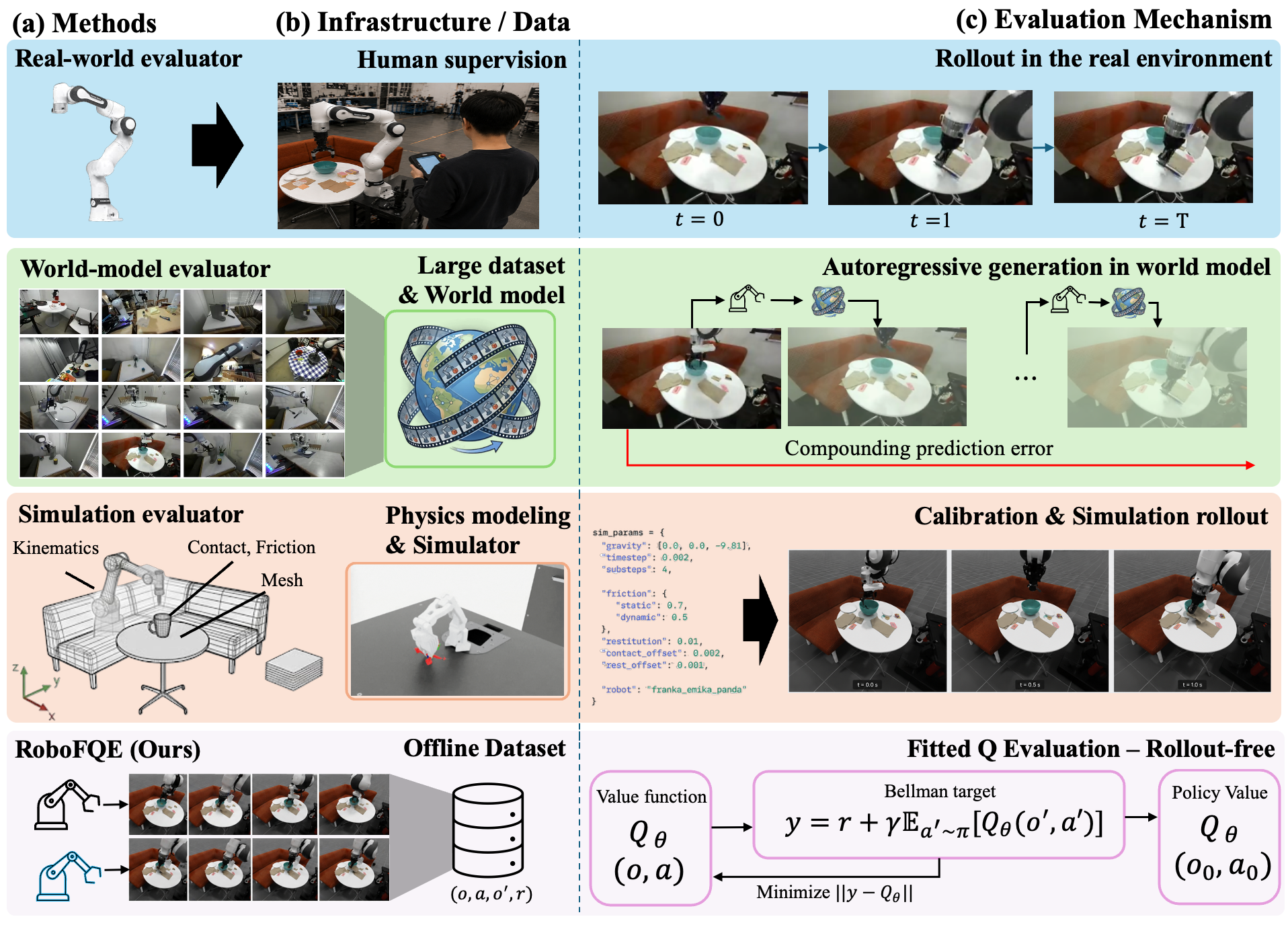
Overview
ImageNet both trains and evaluates vision models; robot datasets should do the same for policies. Every other route makes the policy act somewhere first. On the robot, each trial costs scene setup, resets and human supervision. A simulator has to be reconstructed and calibrated, and still carries the sim-to-real gap. A video world model generates the rollout chunk by chunk from its own earlier frames, and prediction error compounds over a long manipulation sequence.
RoboFQE is fitted Q-evaluation made to work on visual robot policies. It regresses the policy's Q-function onto trajectories that already exist, teleoperation demonstrations, rollouts of earlier checkpoints, open datasets, and reads the value off the first step of each trajectory. The policy is only asked which action it would take at inputs the data already holds. With a binary terminal reward and \(\gamma=1\), the quantity estimated is the success rate itself, so RoboFQE can say whether a checkpoint clears a deployment threshold, not only which checkpoint is better. On LIBERO-Long its relative return error is 5.63% where the strongest video world-model evaluator reaches 54.4%.
Method
Offline data. Recorded trajectories of the task: an instruction, observations and actions, typically with no reward channel and no record of how likely each action was. RoboFQE needs no action probabilities, neither the data collector's nor the evaluated policy's; it only samples the policy's actions. What the data must do is cover the evaluated policy, failures included: on LIBERO, 50 demonstrations per task plus 25 rollouts of partially trained checkpoints give 5 to 10 times lower error than the demonstrations alone.
Success detector. When trajectories carry no success labels, LRM, a vision-language reward model, judges success from each trajectory's final frame and its instruction. Every trajectory is labeled once, and the labels serve every policy evaluated on that data; after fine-tuning on the LIBERO demonstrations, LRM agrees with the simulator on 97.4% of the rollouts.
Q-network and target. \(Q_\theta(x_t,a_t,l)\) reads exactly what the policy reads: the images through a DINOv3 backbone fine-tuned by the FQE loss, proprioception, gripper state and the action through learned embeddings, and the instruction \(l\) through a pretrained text encoder. It outputs one number, the discounted chance that the task ends in success if the policy takes over after this action. It is regressed onto a one-step target at every recorded transition: at a trajectory's last step the success label, at every earlier step \(\gamma\) times the Q-value of the next recorded input under the action the evaluated policy would choose there. The policy contributes actions, and no frame is ever generated. The pretrained backbone carries most of the accuracy: a ResNet-18 trained from scratch in its place raises the error on every suite, most of all on LIBERO-Long, from 5.63% to 32.09%.
Results
RoboFQE is tested on four LIBERO suites with horizons from 220 to 520 steps and on CALVIN chains of five subtasks with the X-VLA policy, against three video world-model evaluators: WorldGym, Cosmos 2.5-AC and Ctrl-World. It has the lowest return error on every suite, and its rankings hold as well: Pearson \(r\) against the true return is +0.88 to +0.96, the highest in every case. On CALVIN it matches the first-subtask success rate, 0.95 against 0.96, and follows the chain to an average of 3.61 completed subtasks against a true 4.32, while every world-model evaluator is at zero by the fifth subtask.
Citation
@inproceedings{deng2026robofqe,
  title={RoboFQE: Rollout-Free Evaluation of Visual Robot Policies from Offline Trajectories},
  author={Deng, Yunfu and Shin, Sangwoo and Pavse, Brahma and Hanna, Josiah P},
  booktitle={Conference on Robot Learning (CoRL)},
  year={2026},
  organization={PMLR}
}